| VEHICLE FITMENT | |
| TYPE | Heavy-Duty Flat Conveyor Chain |
| OE NUMBER | |
| MATERIAL | Metal |
| VEHICLE FITMENT | |
| TYPE | Heavy-Duty Flat Conveyor Chain |
| OE NUMBER | |
| MATERIAL | Metal |
| SIZE | Standard size or ODM size |
| CUSTOMIZED | Yes |
| CONDITION | Brand new |
| MOQ | |
| PACKAGE | Standard or as customer requirements |
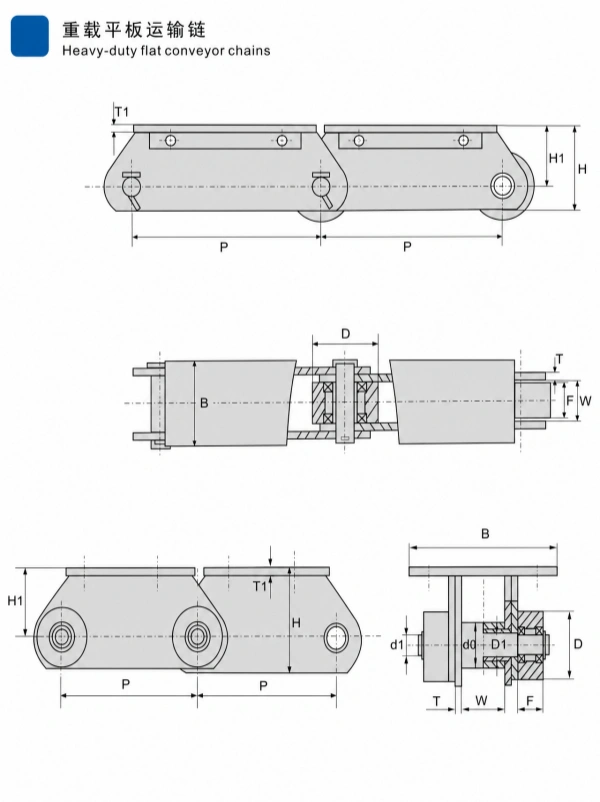
Heavy-duty flat conveyor chains are engineered plate chains designed for demanding material-handling and continuous conveying systems. The supplied technical drawing shows a flat conveyor chain with broad plate surfaces, connecting pins, rollers or bush components, and Type A / Type B plate configurations.
The drawing includes:
The supplied parameter table contains the following models:
All precise values on this page are transcribed from the supplied technical image. Public sources are used only for general conveyor-chain application and selection background.
The flat plate structure provides a broad conveying surface for supporting and moving loads through an engineered conveyor layout. The exact plate dimensions and Type A / Type B geometry should be selected according to the equipment design and conveyed material.
The supplied models cover pitch values from 75 mm to 550 mm, providing options for different chain layouts and load-handling requirements.
The drawing includes the following visible references:
Heavy-Duty Flat Conveyor Chain | Type A and Type B Plate Chain
The ZP400 Type A fields are blank in the supplied source image and are intentionally shown as blank. No values have been inferred.
Public conveyor-chain references describe heavy-duty conveyor chains and flat plate chains for applications such as:
The correct application depends on the conveyed load, support conditions, chain speed, impact, conveyor length, sprocket design, plate configuration, and operating environment.
Provide the following information for chain matching:
Custom engineering review can be based on:
Material grade, heat treatment, surface treatment, coating, corrosion resistance, service life, certification, noise level, and allowable working load are not specified in the supplied image. Confirm these requirements separately before including them in a purchase specification.
auto parts, construction machinery spare parts and motorcycle parts ,including engine parts ,chassis parts ,braking systems parts,
electrical parts,gearbox parts,hydraulic parts,filter system parts.
 English
 Russian